
NEWS
HIGHLIGHTS
ABOUT US
Clean energy and low-power electronics share a common bottleneck: how ions move through solid materials. We study ion transport in ceramics and turn this knowledge into new solid-state devices. Our devices span from the microwatt to the megawatt range.
From fundamentals to devices
We work along the whole chain, from the fundamentals to the working prototype:
- Materials and Nanoionics. We control how ions travel through oxides and across their interfaces, down to the nanoscale.
- Manufacturing. Thin films and ceramic 3D printing let us build cell designs that conventional ceramic processing cannot produce, using fewer critical raw materials.
- Characterisation and AI. We test many materials in parallel and observe them while they operate. The resulting datasets feed AI tools that speed up discovery, on the way to self-driving laboratories.
- Devices and systems. We build and test prototypes under realistic conditions, together with industrial partners.
What we build
- Ceramic fuel cells. Ceramic devices that turn hydrogen or other fuels into electricity, or electricity into hydrogen, by using oxygen ions or protons as charge carriers.
- Full-oxide batteries. Safe, non-flammable batteries made entirely of oxides, for sensors in industry and critical infrastructure. Besides lithium, we explore alternative chemistries such as sodium ions, oxygen ions and protons.
- Ion-driven computing. Devices that process information by moving ions, not only electrons. Like synapses in the brain, they remember their past activity. This lets them compute with ultra-low energy directly on sensors and small devices.
We combine long-term research with industrial collaboration, from mature fuel-cell technology to emerging fields such as all-solid-state energy storage, protonics and ionotronics. Meet our team, explore our facilities and browse our publications.
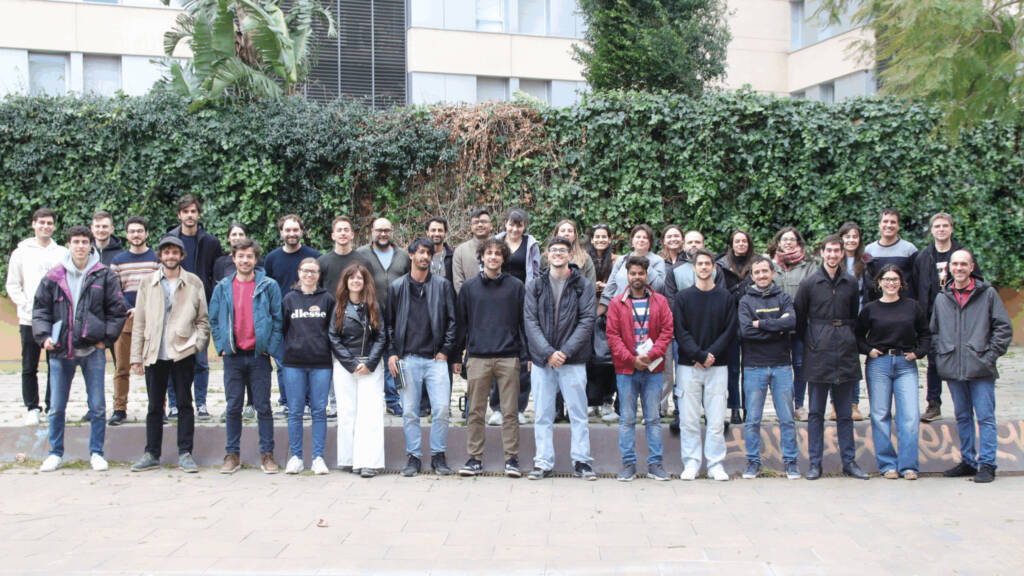
The Nanoionics and Fuel Cells group at IREC, 2025. See our group page at irec.cat

OUR HISTORY IN A NUTSHELL
ATLAB was launched in 2010 as one of the first research groups at the Catalonia Institute for Energy Research (IREC). The idea was to combine fundamental and applied research on mass transport – how ions move through solid materials – and on nanoscale phenomena, in order to develop new solid-state energy devices.
The first years were devoted to consolidating our main research lines, creating key permanent positions and setting up laboratories for manufacturing and characterisation. Our first EU-funded projects, SAPIENS (2012) and SiNERGY (2013), started a steady growth in staff, budget and research network.
Step by step, strong alliances with national, international and industrial partners brought new opportunities and international visibility. Two milestones in 2016 launched new independent research lines: the coordination of the Cell3Ditor project started our work on 3D printing of solid oxide cells, and the ERC Consolidator Grant ULTRASOFC started our work on interface-dominated micro power sources. In 2018 the group leader was awarded an ICREA Professorship, and the Generalitat de Catalunya recognised ATLAB as a Consolidated Research Group (SGR).
Internationally, we have organised leading European conferences in solid-state ionics (E-MRS Spring Meeting symposia in 2018 and 2020, with more than 200 abstracts) and thermoelectrics (European Conference on Thermoelectrics, ECT 2022). Our group leader has joined the editorial boards of the Journal of the European Ceramic Society (Elsevier) and Journal of Physics: Energy (IOP), and has guest-edited special issues of Advanced Materials Interfaces and Journal of Physics: Energy, among others.
Today, ATLAB is a well-established research group with a wide network of collaborations and an annual budget well above €2 million. See our current projects and collaborations.
Research lines
Applications

Ceramic fuel cells
Ceramic cells that turn hydrogen or other fuels into electricity, or electricity into hydrogen.
Learn more
Full-oxide batteries
Safe, non-flammable batteries made entirely of oxides, for sensors and critical infrastructure.
Learn more
Ion-driven computing
Devices that store and process information by moving ions, using ultra-low energy.
Learn moreEnabling technologies

Advanced manufacturing
Thin films and ceramic 3D printing for cell designs that conventional processing cannot make.
Learn more
Accelerated research
High-throughput testing and AI tools that speed up the discovery of new materials.
Learn more
Advanced characterisation
We observe materials and devices while they operate, under realistic conditions.
Learn moreJOIN US OR COLLABORATE
We welcome students, researchers and industrial partners who want to work on solid-state energy and ionic devices. See our open positions and contact details, or explore our open data.


