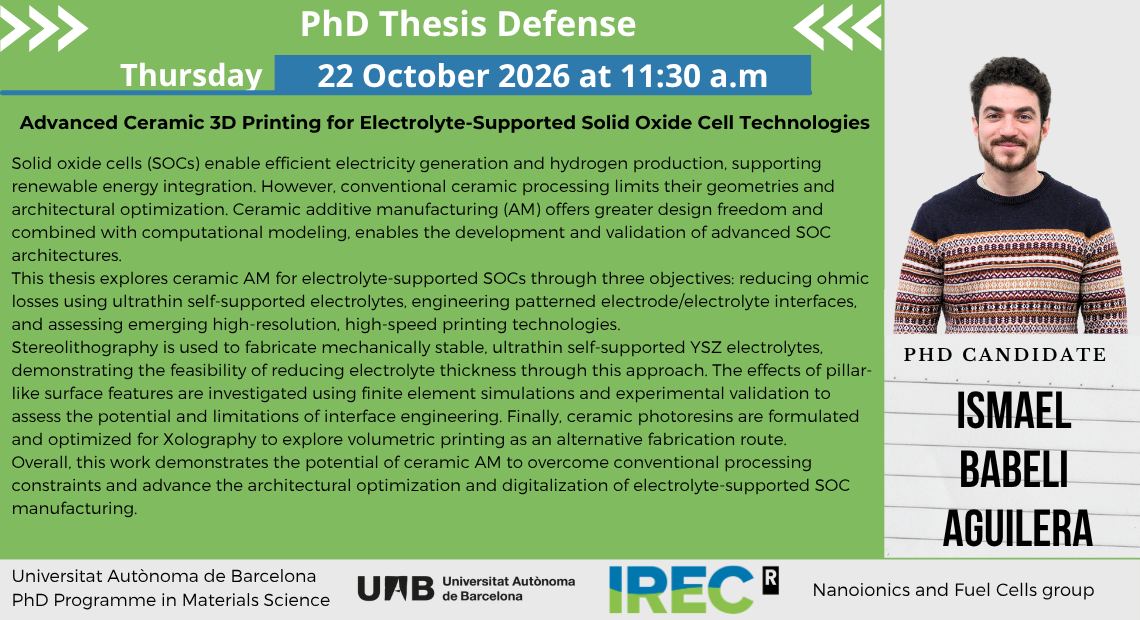
On 22 October 2026, Ismael Babeli Aguilera defended his PhD thesis, “Advanced Ceramic 3D Printing for Electrolyte-Supported Solid Oxide Cell Technologies”, in the PhD Programme in Materials Science of the Universitat Autònoma de Barcelona (UAB).
Solid oxide cells are ceramic devices that turn fuel into electricity, or electricity into hydrogen, with high efficiency. Conventional ceramic processing restricts them to simple, flat shapes. Ceramic 3D printing (additive manufacturing) removes this limit, so each layer can be shaped for better performance.
The thesis pursued three goals:
- Thinner electrolytes. Using stereolithography – printing with light-curable ceramic resins – Ismael produced ultrathin yet mechanically stable self-supported electrolytes of yttria-stabilised zirconia, lowering the electrical resistance of the cell.
- Patterned interfaces. Computer simulations and experiments showed how pillar-like features at the electrode/electrolyte interface affect performance, and where the benefits end.
- Faster printing. New ceramic resins were formulated for Xolography, a volumetric technique that hardens the resin where two light beams of different colours meet, printing a whole part at once.
Together, the results show how 3D printing can overcome the shape limits of conventional processing and move solid oxide cell manufacturing towards a more digital workflow.
Related paper: Architecture-enabled 3D-printed ultrathin electrolyte-supported solid oxide cells (Journal of Power Sources, 2026).
Congratulations, Ismael!
