Neuromorphic hardware facilitates rapid and energy-efficient training and operation of neural network models for artificial intelligence. However, existing analog in-memory computing devices, like memristors, continue to face significant challenges that impede their commercialization. These challenges include high...
Read moreAnalog reconfiguration of materials and devices with oxygen
Adaptive biological systems dominate nature due to their flexibility. In contrast, human-fabricated electronic devices have limited flexibility and adaptability, as their functionality is mostly fixed during fabrication. Therefore, developing nature-inspired, stimuli-responsive devices has been a long-standing goal...
Read moreTowards the automatic exploration of materials
Accelerated mapping of composition-structure-property relationships is a central goal in current materials research. Advanced approaches leverage machine learning (ML) models on existing databases, including data mining from the literature. However, efficient and effective application of these ML models requires...
Read moreInsights into the LMO Cathode Stability in Aqueous Electrolytes
In this work, a multimodal characterization approach has been used to study the phase and defect evolution upon cycling in aqueous batteries of a well-known yet not fully exploited cathode material, LiMn2O4. This is the first time that Tip-Enhanced Raman Spectroscopy (TERS) is employed to observe defect evolution...
Read more3D printing of reversible solid oxide cell stacks
In this study, electrolyte-supported solid oxide cells, fabricated using 3D printing and combined with ultrathin flat metallic interconnects, were successfully operated in both fuel cell (SOFC) and electrolysis (SOEC) modes. The three-cell substack yielded a maximum power of 27 W (200 mW/cm2) and a maximum injected...
Read more3D printed electrolyte-supported solid oxide cells based on YbSZO
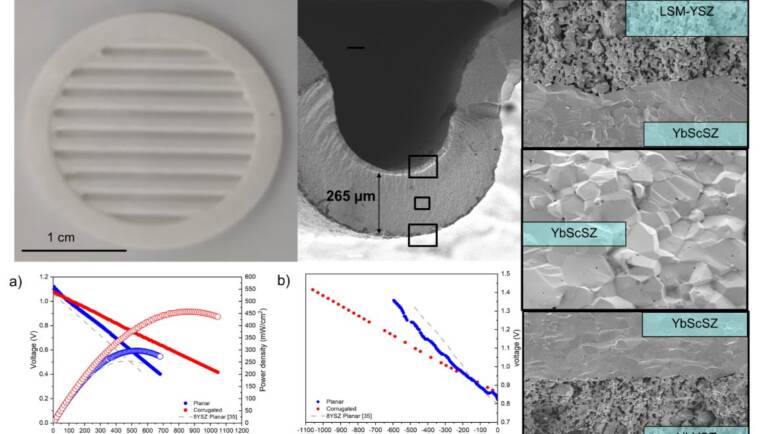
In this work, SLA 3D printing of 6Yb4ScSz has been developed to produce complex-shape electrolytes for SOC applications with better performance than counterparts based on state-of-the-art 8YSZ. Corrugated 6Yb4ScSZ cells presented enhanced values of peak power density and maximum injected current of 470 mW cm−2 and...
Read moreLarge-area 3D printed electrolyte-supported reversible SOC
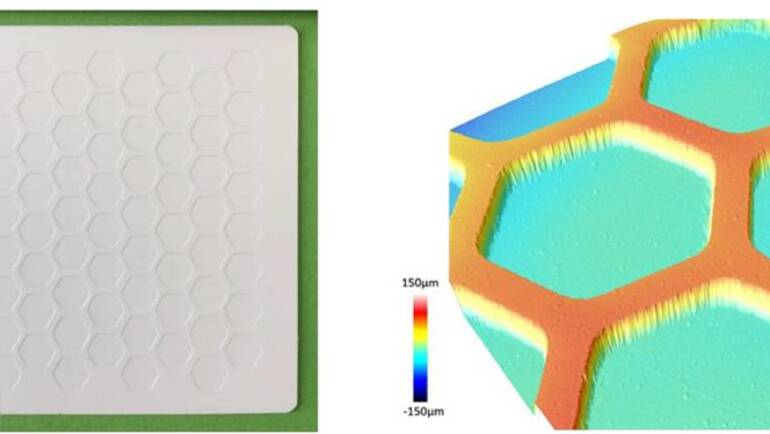
Our newly published paper introduces a groundbreaking approach to manufacture Large Area Solid Oxide Cells via 3D printing that has the potential to revolutionize power generation and energy storage. We proudly present the successful fabrication of large-area solid oxide cells, an impressive 25 cm², operated in...
Read moreBook Release: 3D printing for Energy Applications
3D Printing for Energy Applications, co-authored by Albert Tarancón (ICREA Research Professor and Head of the Nanoionics and Fuel Cells Group at the Catalonia Institute for Energy Research) and Vincenzo Esposito (Professor and Technology Coordinator in Ceramic Science and Engineering at the Department of...
Read moreIREC & Naturgy published a new H2 book (video)
Print your Energy
Three dimensional printing technologies represent a manufacturing revolution because of their unique capabilities for increasing shape complexity while reducing waste material, capital cost and design for manufacturing. However, the application of 3D printing technologies for the fabrication of devices remains an...
Read morePowering the IoT revolution with heat
Standard silicon CMOS technology can create thermoelectric micro-harvesters that could be used to power numerous IoT devices as Albert Tarancon explains in his last publication in Nature.
Read moreWaste heat recovery with the most abundant element: Silicon
Large amounts of waste heat generated in our fossil-fuel based economy can be converted into useful electric power by using the so-called thermoelectric generators. These power generators use temperature differences to generate electricity in a very simple and straightforward way. However, the...
Read more