Some oxides change dramatically – from metal-like to insulating – when oxygen is added or removed. Using a voltage to move oxygen in and out is a way to tune such materials for brain-inspired transistors or smart displays. So far, however, mainly the two extremes (fully oxidised or fully reduced) had been studied.
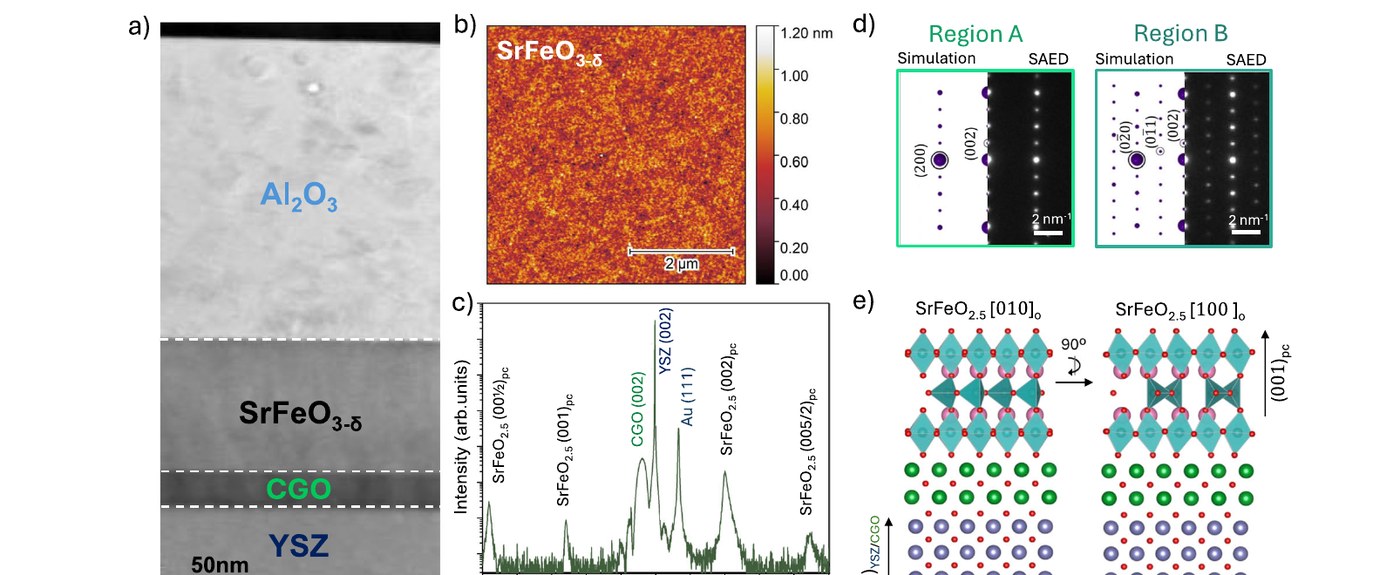
In this work we used an electrochemical “oxygen pump” to change the oxygen content of strontium ferrite (SrFeO3-δ) thin films in small, precisely measured steps. We found that several stable phases can coexist across a wide range of intermediate states. A structural model and a defect-chemistry description explain how the material oxidises under voltage.
These intermediate states open new ways to design ionotronic devices that respond gradually and reversibly to oxygen.
Read the paper: P. Nizet, F. Chiabrera, A. Ruiz-Caridad, A. Kaus, O. Falcó, L. Zhang, L. Yedra, S. Estradé, R. Dittmann, F. Peiró, F. Gunkel, A. Tarancón, “Unlocking stable intermediate states in SrFeO3-δ through voltage control of oxygen non-stoichiometry”, Nature Communications 17, 8289 (2026). https://doi.org/10.1038/s41467-026-75149-8
Figure: Fig. 1 from Nizet et al., Nature Communications 17, 8289 (2026), CC BY 4.0.
