Fuel cells, electrolysers and gas sensors all depend on one key step: oxygen from the gas being split and taken into a solid oxide. How fast this oxygen reduction reaction runs on oxide surfaces varies widely between studies, because the surface keeps changing while the device operates.
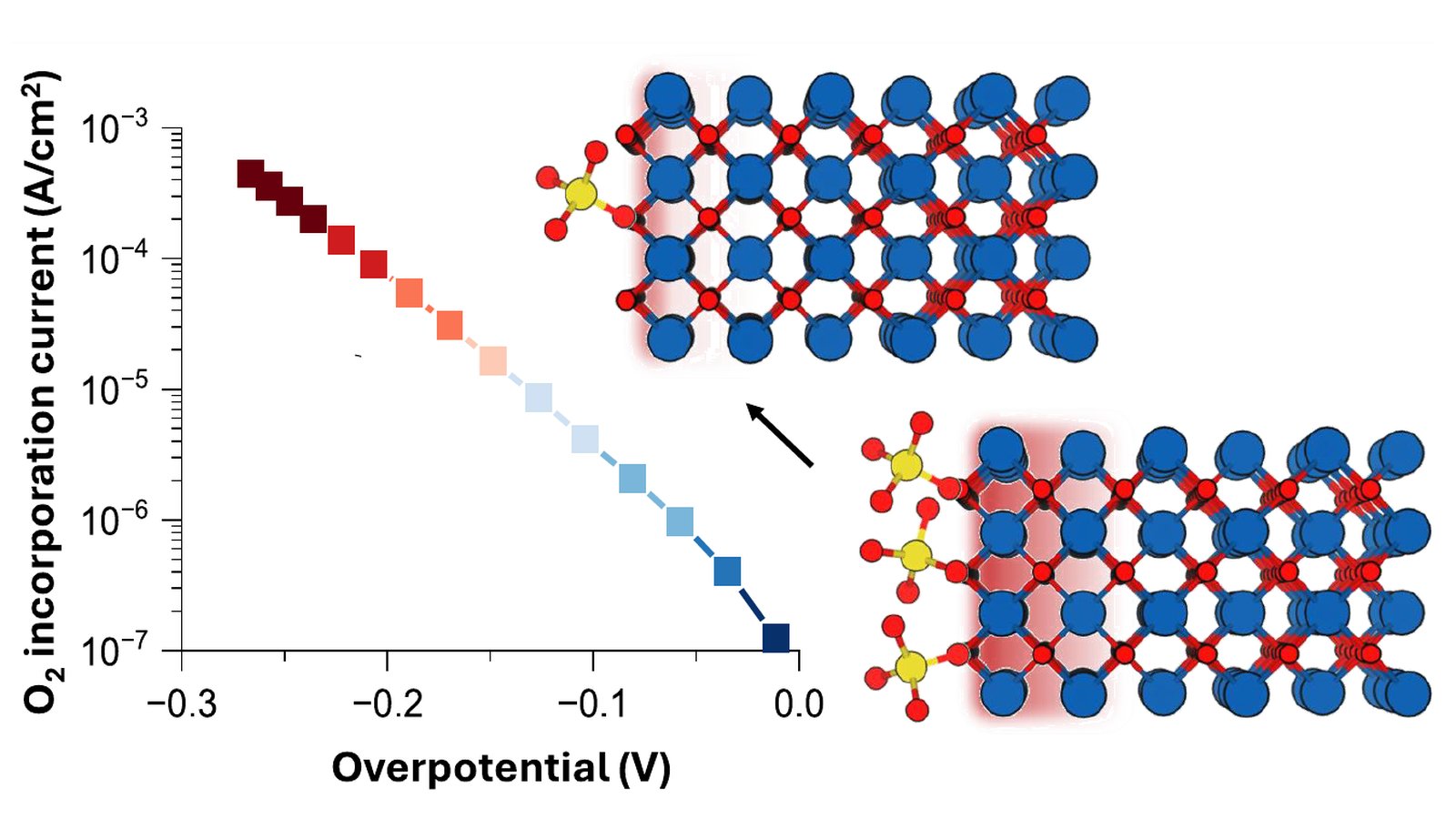
Ceria doped with gadolinium (CGO) is often used as a thin protective layer on fuel cell electrodes, but it is usually considered slow at this reaction. In a new study in the Journal of the American Chemical Society, we show that 10 nm thick CGO films become far more active when a negative voltage is applied. At 500 °C they take up oxygen faster than the widely used electrode material La0.5Sr0.5FeO3−δ and approach the high-performance benchmark La0.6Sr0.4CoO3−δ.
To find out why, we followed the surface during operation with X-ray photoelectron spectroscopy at Diamond Light Source (UK) and examined it at the nanoscale with tip-enhanced Raman spectroscopy. Both reveal traces of sulfate – acidic molecules, most likely formed from minute sulfur impurities in the gas – on the ceria surface. The applied voltage reversibly lowers their coverage by about 40 %. Because sulfate is negatively charged, removing part of it changes the electric field just below the surface and the number of electrons available for the reaction. A model of this charged surface layer reproduces the measurements. Conversely, coating the surface with a basic compound, lithium oxide, cut the electrode resistance more than a hundredfold.
The results show that oxygen uptake in ceria is set by the changing chemistry of its surface, not by the bulk material alone – a guide for designing faster, more stable electrodes.
The work was led by Francesco Chiabrera and Albert Tarancón, with Kosova Kreka, Federico Baiutti, Marlene Anzengruber and Juan Carlos González-Rosillo from our group, together with colleagues at Diamond Light Source. It was funded by the EU Horizon 2020 project EPISTORE (grant 101017709) and a Marie Skłodowska-Curie Postdoctoral Fellowship (grant 101107093).
Read the paper: F. Chiabrera, K. Kreka, F. Baiutti, B. Karagoz, M. Anzengruber, J. C. González-Rosillo, M. Van Spronsen, A. Tarancón, “Dynamic acidic adsorbates govern fast oxygen incorporation in ceria through interfacial electrostatics”, Journal of the American Chemical Society (2026). https://doi.org/10.1021/jacs.6c11743
Figure: abstract graphic from Chiabrera et al., J. Am. Chem. Soc. (2026), licensed under CC BY 4.0.
