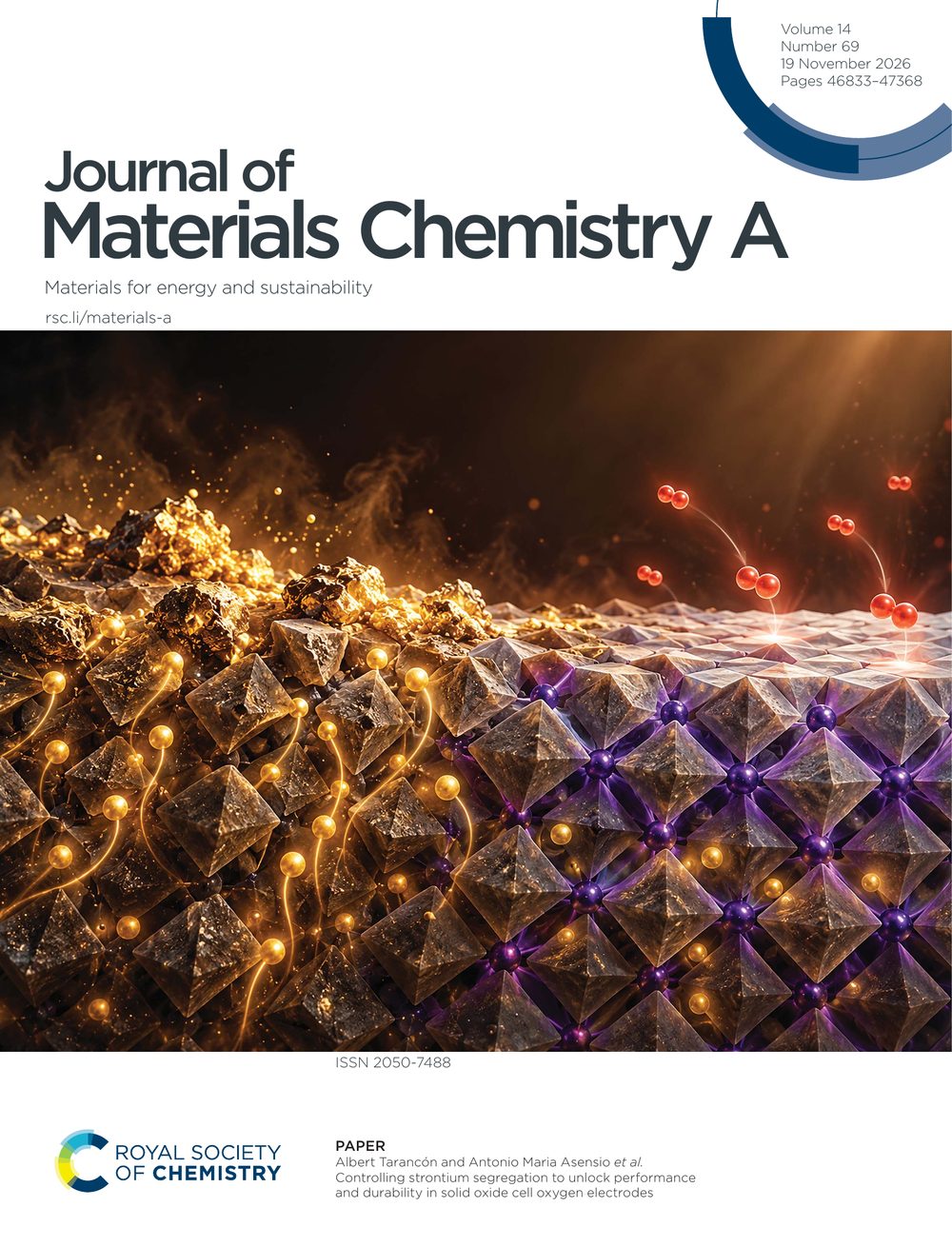
Our study on how manganese keeps strontium in place in fuel cell oxygen electrodes is featured on the front cover of the Journal of Materials Chemistry A (Volume 14, Issue 69, 19 November 2026).
Solid oxide cells convert fuel into electricity – or electricity into hydrogen – using a ceramic electrolyte. One of the main reasons they age is strontium segregation: strontium in the oxygen electrode slowly moves to the surface and forms insulating layers that block the reaction. In the paper, we show that replacing a small part of the cobalt and iron in the widely used electrode material La0.6Sr0.4Co0.2Fe0.8O3-δ with manganese keeps strontium in place. The modified electrodes deliver up to 1.2 W cm⁻² at 0.7 V and 750 °C and degrade more slowly under realistic fuel cell conditions (read our earlier story).
The cover artwork contrasts an electrode surface overgrown by segregated strontium (left) with a stable surface that keeps taking up oxygen from the air (right).
The work was led by Natasha Di Benedetto, with Antonio María Asensio, Juande Sirvent, Kosova Kreka, Lourenço Martinho, Federico Baiutti, Marc Torrell and Albert Tarancón from our group, together with external collaborators.
Read the paper: N. Di Benedetto, A. M. Asensio, J. Sirvent, G. Kerherve, S. Benter, S. Sukumaran, K. Kreka, L. Martinho Serra, F. Baiutti, J. Villanova, S. J. Skinner, M. Torrell, A. Tarancón, “Controlling strontium segregation to unlock performance and durability in solid oxide cell oxygen electrodes”, Journal of Materials Chemistry A 14, 46917–46929 (2026). https://doi.org/10.1039/d6ta06378k
Image: front cover of J. Mater. Chem. A, Volume 14, Issue 69 (2026), © The Royal Society of Chemistry.
